
Incident, 2015
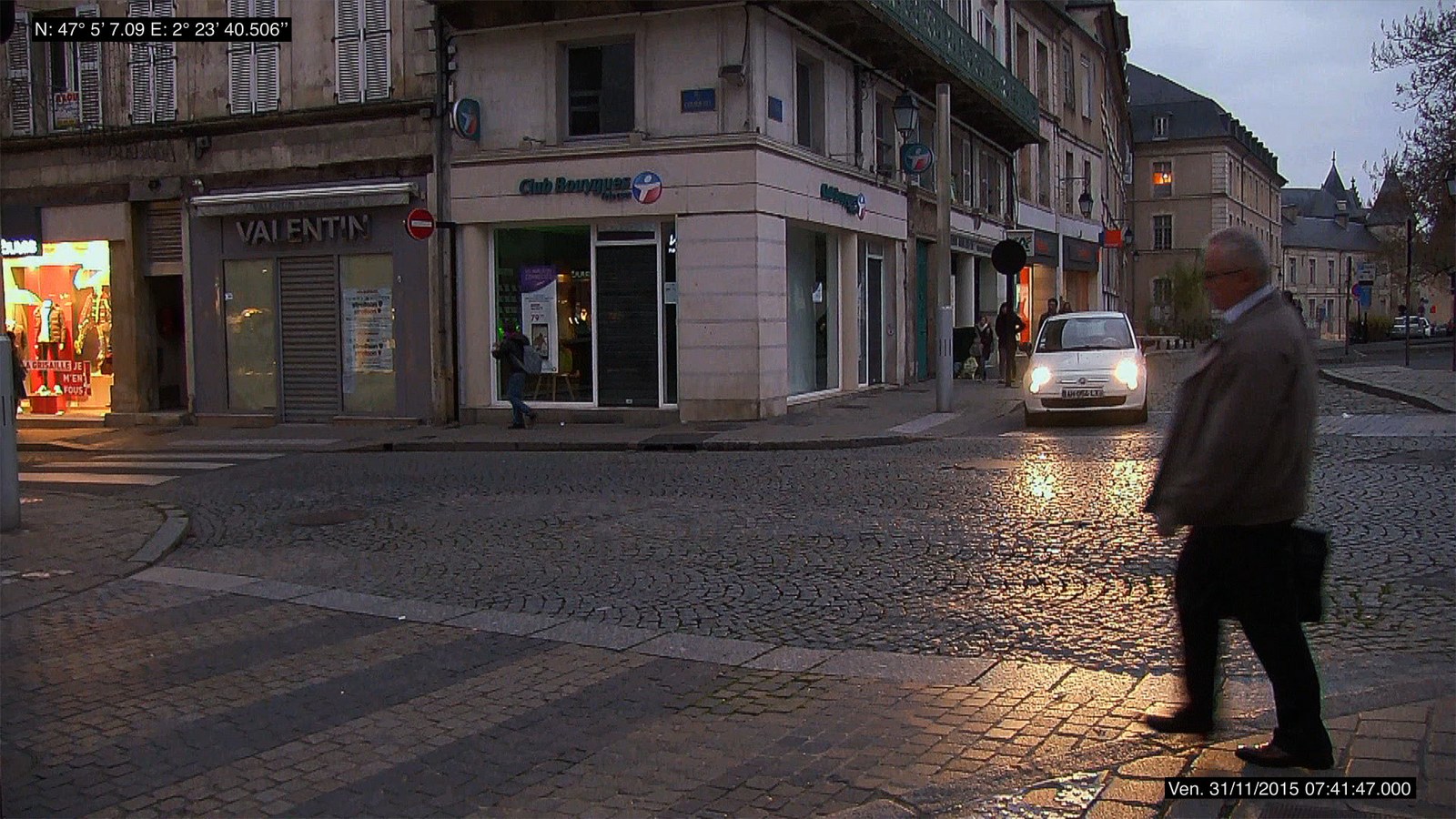
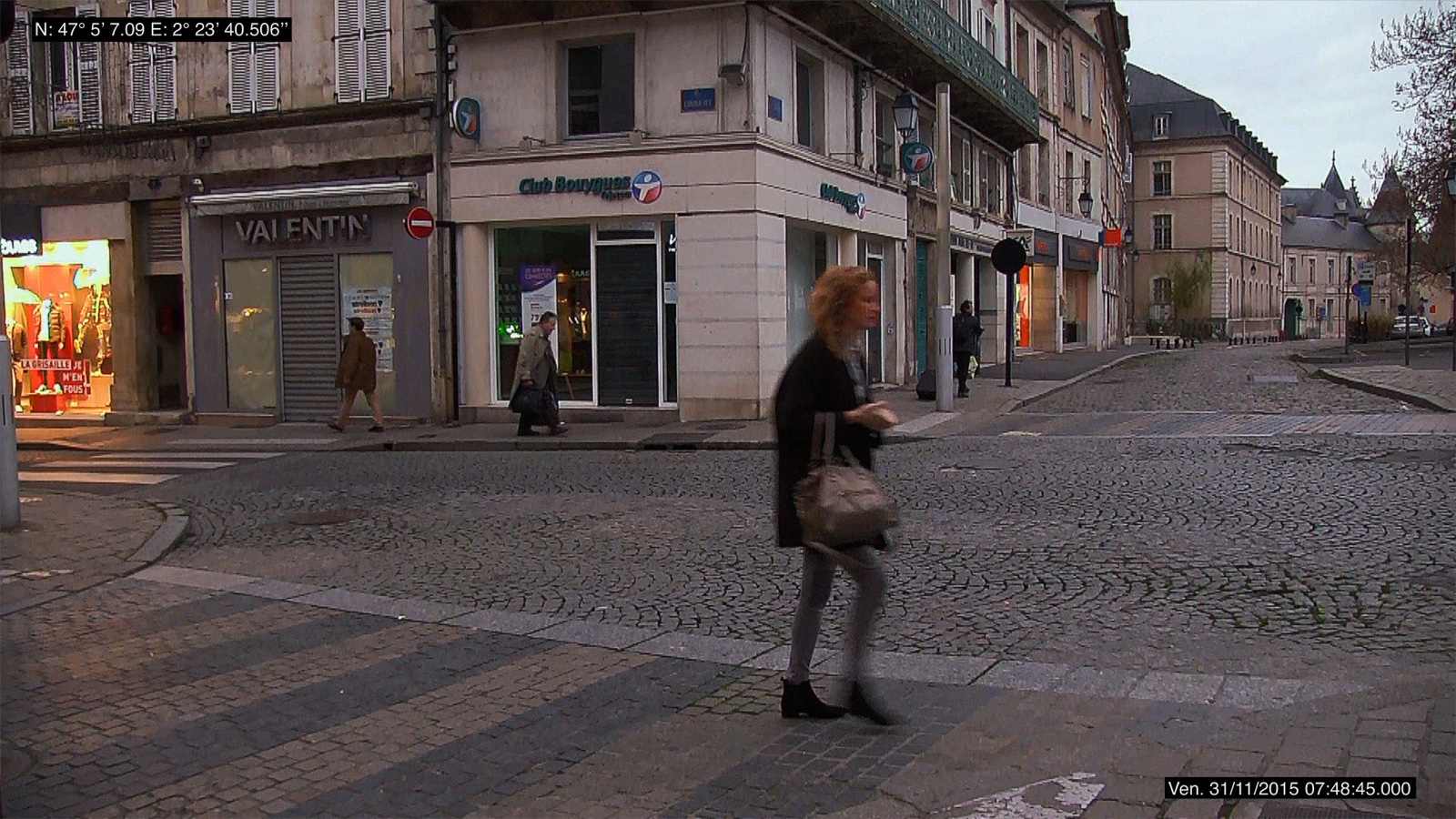
Vidéo numérique HD tournée in situ (coordonnées GPS et horodatage incrustés), durée d'enregistrement variable, en boucle, son
Produit dans le cadre d'une résidence aux Rencontres Bandits-Mages, Château d'eau / Château d'art, Bourges, 2015. Commissariat : David Legrand et Maxime RouchetHD digital video shot in situ (GPS coordinates and timecodes burnt in), variable recording length, looped, sound
Produced during a residency at Rencontres Bandits-Mages, Château d'eau / Château d'art, Bourges, 2015. Curated by David Legrand and Maxime Rouchet
Une voix répète : « avant ». Un peu plus tard : « après ». Entre les deux, on cherche. Sur le moniteur, des photogrammes s'affichent au hasard, horodatés, géolocalisés. Ils sont extraits d'un plan fixe, filmé à hauteur du regard, dans un lieu de passage situé à quelques mètres de l'espace d'exposition — la rue que le visiteur vient de traverser pour entrer.
Le procédé n'est pas inventé : c'est celui qu'emploient les opérateurs de vidéosurveillance pour retrouver, dans une masse d'images, l'occurrence d'un événement. On balaie, on annonce un « avant » et un « après », on resserre. Ici, le protocole tourne à vide. Aucun événement n'est recherché, puisqu'il n'y en a pas.
La bande sonore continue pourtant de scander ses repères, imperturbablement, en boucle. Et le regard se met au travail : il fouille l'image, il compare, il attend l'incident, il finit par le trouver — dans un geste banal, un croisement de passants, une ombre. C'est la découverte de la pièce : le protocole ne trouve pas l'incident, il le fabrique. Il suffit d'annoncer qu'il y a un avant et un après pour qu'un spectateur produise l'événement qui les sépare.
Reste la place du moniteur. Une image de contrôle ne s'expose pas : elle se surveille, dans un poste, par un agent payé pour cela. Ici, elle est offerte à un public qui n'a rien à surveiller — et qui surveille quand même. Le lieu filmé est celui où l'on se tenait dix minutes plus tôt, sans y penser. En sortant, on le traversera de nouveau. On saura, cette fois, qu'il est en train d'être regardé.
A voice repeats "before". A little later: "after". In between, we search. On the monitor, single frames appear at random, time-stamped and geolocated. They are pulled from a static shot, taken at eye level, of a thoroughfare a few metres from the exhibition space — the street the visitor walked down on the way in.
The procedure is not invented. It is the one CCTV operators use to locate the occurrence of an event inside a mass of footage: scan, call out a "before" and an "after", narrow the window. Here the protocol runs empty. No event is being looked for, because there is none.
The soundtrack keeps calling out its markers anyway, imperturbably, on a loop. And the eye starts working: it combs the image, compares, waits for the incident, and eventually finds one — in an ordinary gesture, two passers-by crossing, a shadow. That is the finding of the piece: the protocol does not locate the incident, it manufactures it. Announcing that there is a before and an after is enough to make a viewer produce the event that separates them.
Then there is the monitor itself. Control footage is not exhibited: it is watched, in a back room, by someone paid to watch it. Here it is handed to an audience with nothing to watch over — and the audience watches anyway. The place on screen is the place you were standing in ten minutes ago, without thinking about it. On the way out you will cross it again. This time you will know it is being watched.