Gaïa N°2Gaia No. 2, 2024
10 × 15 cm
D'après le modèle Sol de Terra Forma. Manuel de cartographies potentielles, Frédérique Aït-Touati, Alexandra Arènes et Axelle Grégoire, éditions B42, 201910 × 15 cm
After the Soil model from Terra Forma: A Book of Speculative Maps, Frédérique Aït-Touati, Alexandra Arènes and Axelle Grégoire, MIT Press, 2022
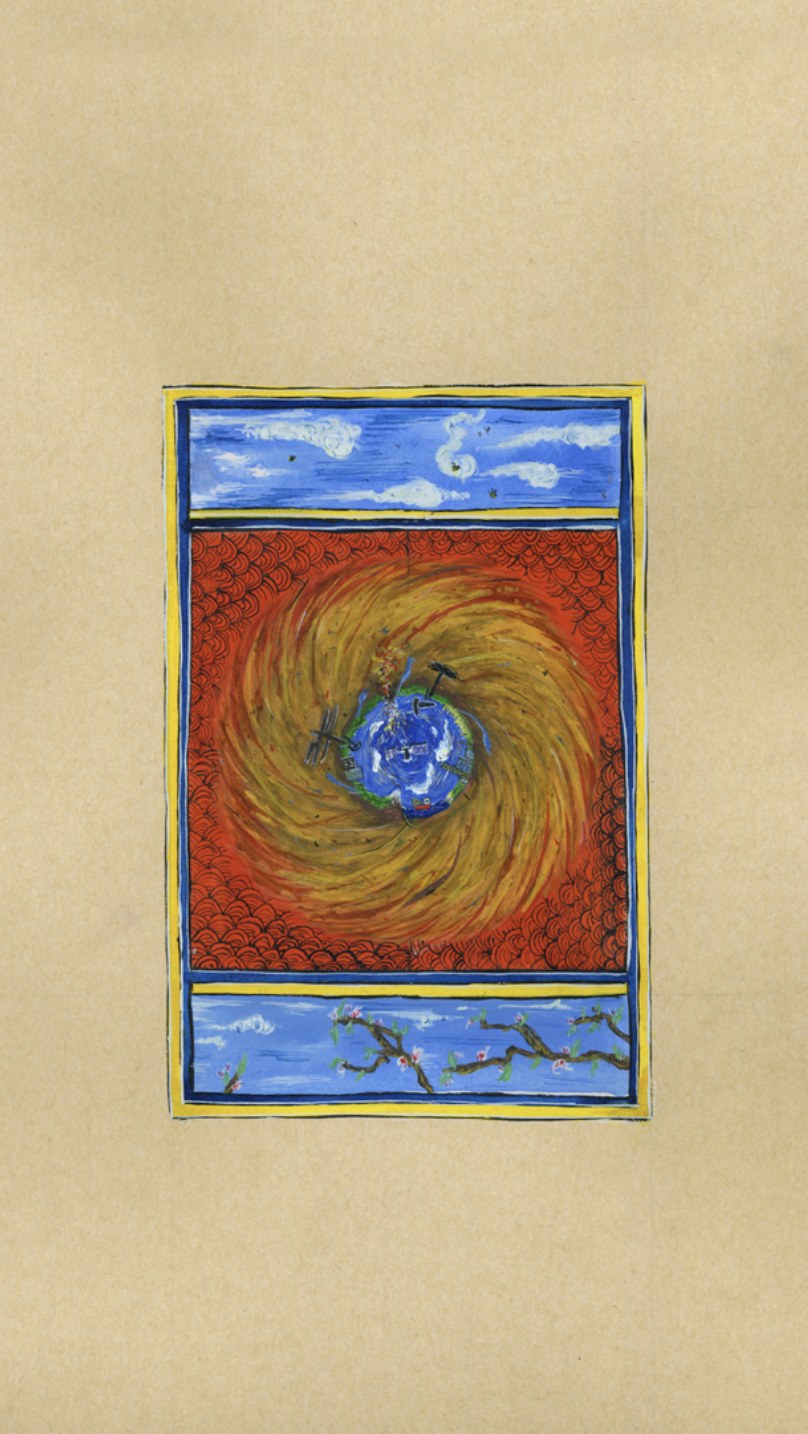
Grande comme la paume, la peinture paraît d'abord montrer la Terre vue de l'espace : un petit globe bleu et vert, cerné d'un vaste tourbillon. Mais le globe a été retourné. Ce bleu central n'est pas l'océan : c'est l'atmosphère, refermée au cœur du monde. Les continents ne font plus une sphère pleine ; ils se réduisent à une fine couronne (la peau mince où l'air, l'eau, la roche et le vivant se touchent). Autour, la spirale ocre et rouge, semée d'arcs concentriques empruntés au signe cartographique de la mer, n'est pas une tempête mais le magma des profondeurs, sa lente circulation.
Dans ce tourbillon gravitent des satellites, un télescope, des panneaux solaires : les instruments par lesquels notre époque mesure et surveille sans relâche cette fine zone habitable. La spirale les entraîne sans les dissoudre. Peinte à l'aquarelle, isolée par une large réserve de papier, la scène ne décrit pas une planète posée dans le vide : elle en propose un modèle retourné, où l'atmosphère devient le centre et la Terre, une membrane vivante à habiter.
No larger than a palm, the painting seems at first to show the Earth from space: a small blue-and-green globe wrapped in a vast swirl. But the globe has been turned inside out. The blue at the centre is not the ocean; it is the atmosphere, shut into the heart of the world. The continents no longer make a full sphere — they shrink to a thin ring (the fine skin where air, water, rock and the living touch). Around it the ochre-and-red spiral, sown with the concentric arcs that old maps used for the sea, is no storm but the magma of the depths and its slow circulation.
Satellites, a telescope and solar panels orbit within that swirl: the instruments by which our age measures and watches this narrow habitable band without pause. The spiral carries them along without dissolving them. Painted in watercolour and set off by a wide reserve of paper, the scene does not depict a planet resting in the void: it offers an inverted model of it, where the atmosphere becomes the centre and the Earth a living membrane to be inhabited.