
Contrat Social (La désinstitutionnalisation)Social Contract (Deinstitutionalisation)
25 min · 2K couleur · son 5.1 et 2.0 · 1.3325 min · 2K colour · sound 5.1 and 2.0 · 1.33
Série Contrat socialFrom the series Contrat social
Production 2019–2025Production 2019–2025
L'Atelier à ImagesL'Atelier à Images
Contrat Social, 2019 — 2025
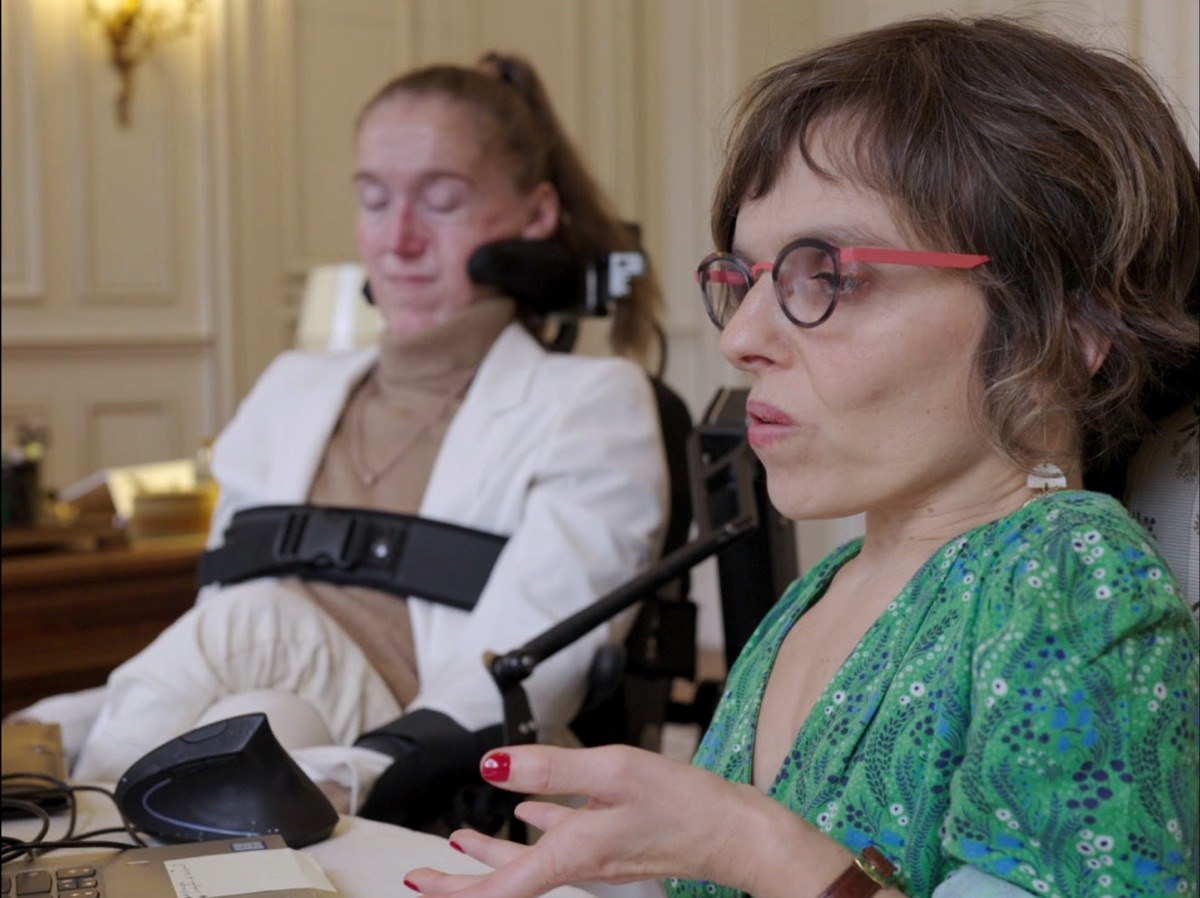
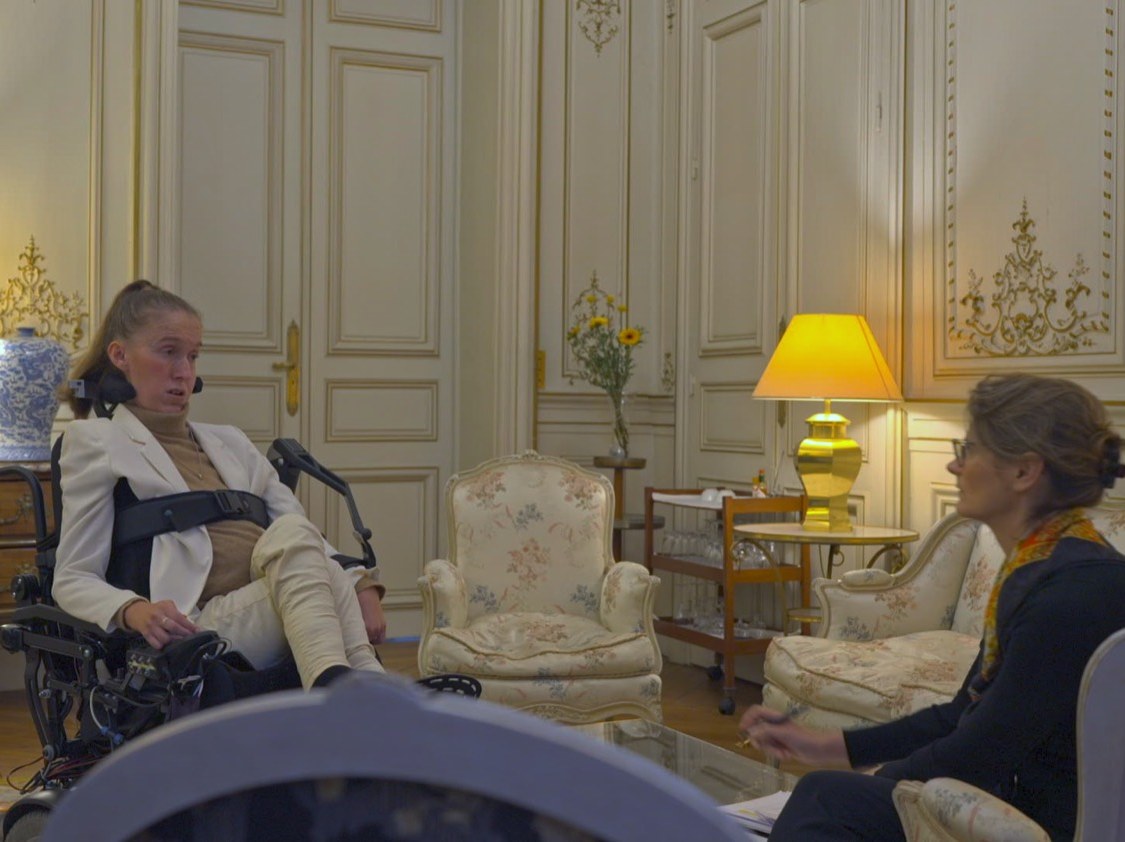
Un huissier ouvre les doubles portes capitonnées. Mathilde Fuchs, militante pour l'émancipation des personnes handicapées, rejoint son bureau en fauteuil roulant : elle est, pour une journée, Première Ministre de la France. À ses côtés une autre militante antivalidiste, Cécile Morin, tient le rôle de conseillère spéciale.
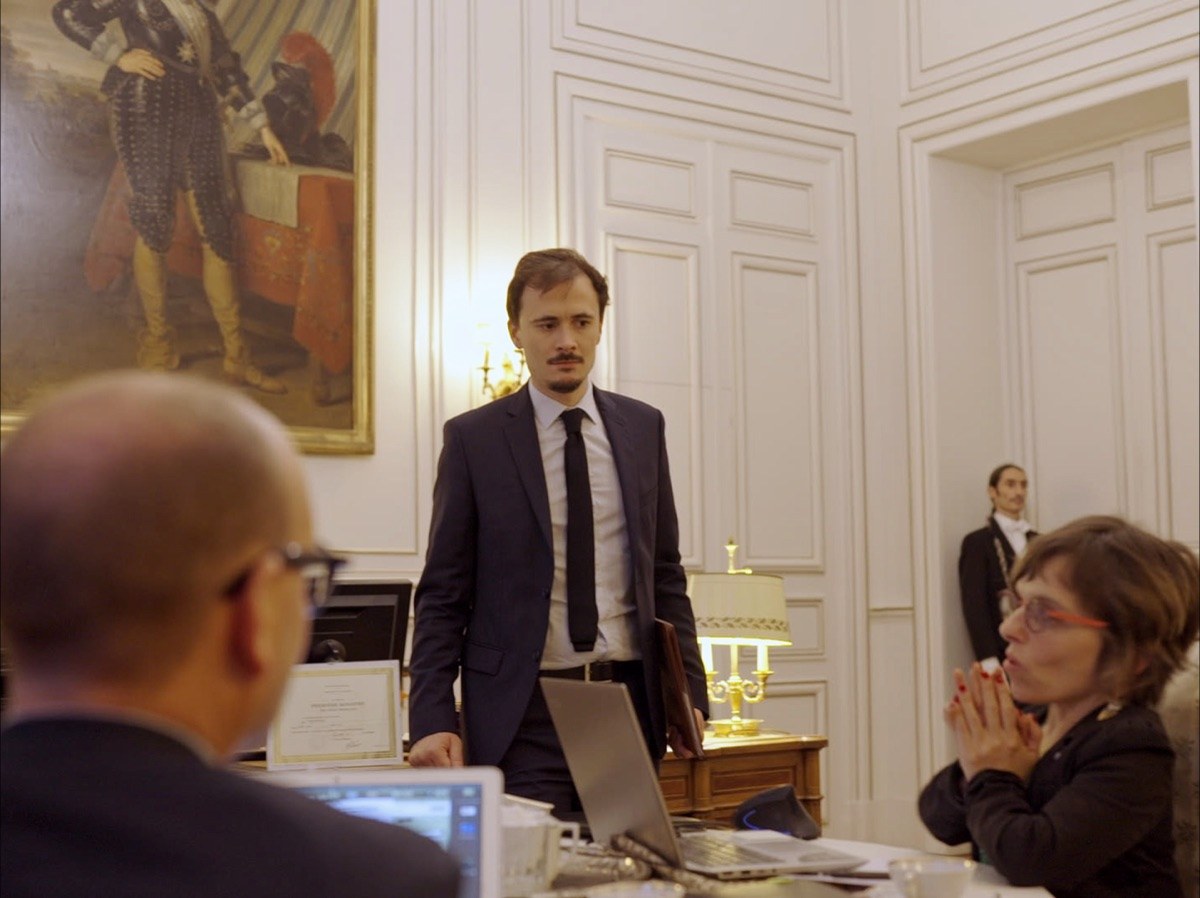
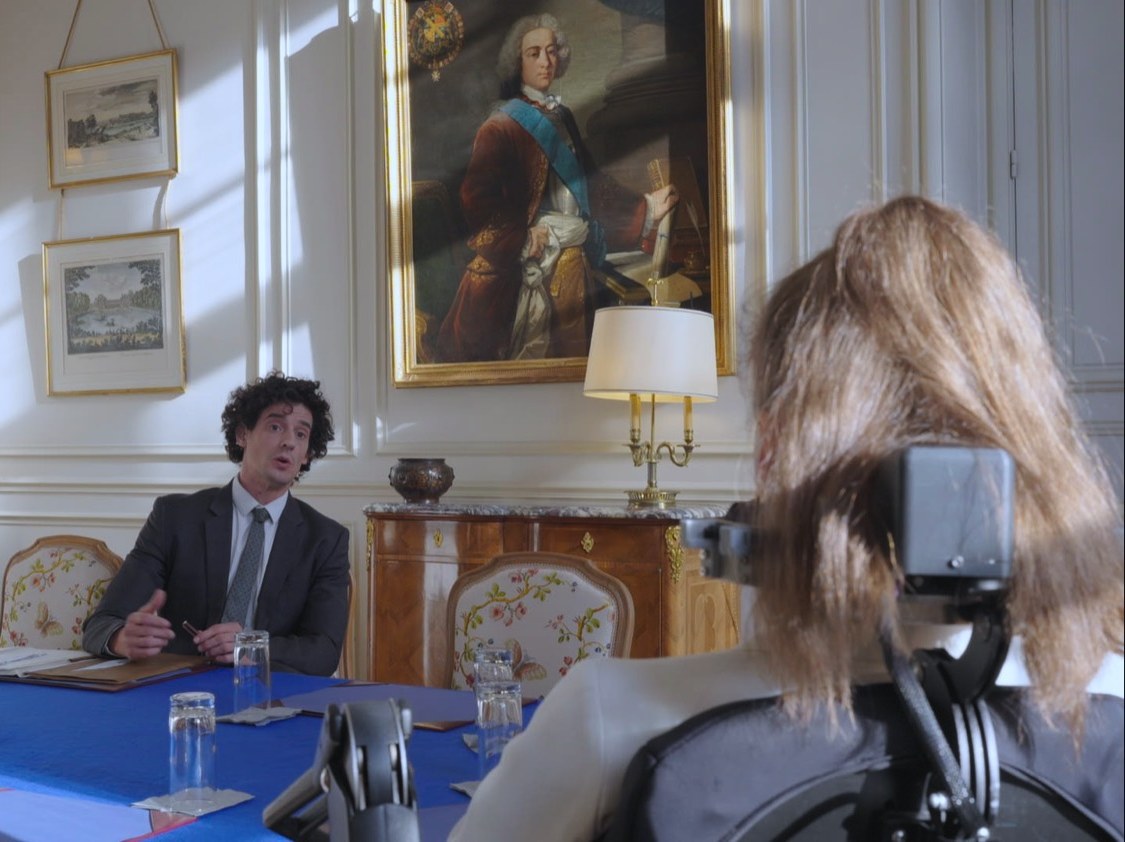
Dans les salons de l'Hôtel de Noirmoutier, un agenda ministériel rythme les heures. De vrais hauts fonctionnaires apportent l'expertise de l'État. Des comédiens formés à l'improvisation — porte-parole, députée, conseillère en communication — viennent s'entretenir avec la première ministre, ils objectent, exposent, relancent. Personne n'a de texte. Absent du plateau, je conduis ces entretiens depuis une salle à proximité, par comédiens interposés.
Tout le monde y croit et la parole change de régime. Mathilde et Cécile ne témoignent plus d'un vécu : elles arbitrent, tranchent, annulent un rendez-vous, écrivent une réforme. Le cinéma est une machine à conférer du pouvoir ; ici, ce pouvoir est retourné et remis à celles qui en sont ordinairement privées. La mise en jeu — un jeu sans vainqueur, fait pour mettre en tension et faire interagir — révèle alors ce que l'espace public interdit d'ordinaire : une personne handicapée portant la parole décisionnaire et non celle du témoignage.
À dix-huit heures, face caméra, le discours rédigé au fil de la journée redéfinit la vie autonome : « pouvoir mener sa vie comme on le souhaite, avec toute l'aide dont on a besoin ». Rien de cela n'existait avant le tournage. Le film ne constate pas le monde : il instaure une situation qui n'aurait pas eu lieu sans lui, et la filme en train d'advenir.
An usher opens the padded double doors. Mathilde Fuchs, an activist for the emancipation of disabled people, wheels herself to her desk: for one day, she is Prime Minister of France. At her side, another disability-rights activist, Cécile Morin, serves as her special adviser.
In the salons of the Hôtel de Noirmoutier, a ministerial agenda sets the pace. Real senior civil servants bring the expertise of the State. Actors trained in improvisation — a government spokesperson, an MP, a communications adviser — come to confer with the Prime Minister; they object, lay out their case, press further. No one has a script. Absent from the set, I conduct these interviews from a room nearby, through the actors as my go-betweens.
Everyone plays along, and the speech changes register. Mathilde and Cécile no longer testify to a life: they arbitrate, decide, cancel a meeting, draft a reform. Cinema is a machine for conferring power; here that power is turned around and handed to those ordinarily denied it. Putting into play — a game with no winners, built to create tension and interaction — then reveals what public space ordinarily forbids: a disabled woman carrying the decision-making voice, not the voice of testimony.
At six in the evening, facing the camera, the speech written over the course of the day redefines independent living: “to lead one's life as one wishes, with all the help one needs.” None of this existed before the shoot. The film does not observe the world: it instaures a situation that would not have taken place without it, and films it coming into being.
L'exercice du pouvoir transforme la pensée Exercising power transforms thought
Contrat social : la désinstitutionnalisation repose sur une hypothèse simple : l'exercice du pouvoir transforme la pensée. En confiant, le temps d'une journée, les fonctions de Premier ministre à des citoyens directement concernés par une question de société, le film ne cherche pas à produire une fiction politique, mais à créer les conditions d'une véritable élaboration collective.
Le dispositif suspend momentanément les hiérarchies habituelles pour déplacer le regard : ce ne sont plus les institutions qui produisent la parole politique, mais la parole qui réinvente les institutions. Investis de responsabilités, confrontés à des interlocuteurs et à des situations inspirés du fonctionnement réel de l'État, les participants voient leurs intuitions s'affiner, leurs arguments se construire et leurs propositions se confronter à la complexité du réel.
Le film envisage ainsi le cinéma comme un espace d'expérimentation politique. En fabriquant une situation crédible, il rend visibles des imaginaires institutionnels qui demeurent le plus souvent inexprimés et affirme que la politique ne se réduit pas à l'exercice du pouvoir : elle naît avant tout de la capacité collective à imaginer d'autres formes d'organisation de la vie commune.
Le cinéma n'est pas ici un outil d'enregistrement du réel ; il est un dispositif qui produit des situations inédites afin de rendre observables des formes politiques latentes.
Contrat social : la désinstitutionnalisation rests on a simple hypothesis: exercising power transforms thought. By handing the office of Prime Minister, for a single day, to citizens directly concerned by a public question, the film does not set out to produce political fiction, but to create the conditions for a genuine collective elaboration.
The dispositif briefly suspends the usual hierarchies in order to shift the gaze: institutions no longer produce political speech — speech reinvents institutions. Vested with responsibility, faced with interlocutors and situations drawn from the actual workings of the State, the participants see their intuitions sharpen, their arguments take shape, and their proposals meet the complexity of the real.
The film thus conceives of cinema as a space for political experiment. By fabricating a credible situation, it makes visible institutional imaginaries that most often go unexpressed, and holds that politics cannot be reduced to the exercise of power: it arises first of all from the collective capacity to imagine other ways of organising common life.
Here cinema is not a tool for recording the real; it is a dispositif that produces unprecedented situations in order to make latent political forms observable.
Int. / Nuit / Cabinet ministériel Int. / Night / Ministerial office
La nuit est tombée.
Tandis que la Première Ministre s'est retranchée dans son bureau pour une ultime répétition de son discours, Cécile Morin aborde la possibilité que le gouvernement soit représenté dans une émission de télévision grand public intitulée « Qu'est-ce qu'on en pense ? », présentée par un certain Cédric Mazouz. Les deux conseillers mettent en avant l'idée qu'envoyer une personne handicapée pour discuter les réformes à venir du gouvernement en cette matière serait judicieux. L'ambiance de fin de journée est décontractée. La conseillère en communication rappelle à quel point il est important de « raconter une histoire », le conseiller politique rebondit avec enthousiasme.
C'est sûr qu'il faut faire pleurer dans les chaumières si on y va, ça on est bien d'accord…
Oui, si on va dans ce genre d'émissions, allons là-dedans.
Le problème, c'est que la médiatisation des personnes handicapées passe toujours par le biais du témoignage. Cela change là avec Madame La Première Ministre… Mais autrement, vous avez toujours d'un côté la personne qui porte la parole décisionnelle, généraliste, universaliste et la personne handicapée qui ne peut témoigner que d'un vécu, circonstancié et enfermé dans sa propre expérience. Comme si une personne handicapée n'était pas capable de porter une parole plus large, de prescription.
Face à la conseillère spéciale, elle-même en situation de handicap, les deux conseillers, en politique et en communication, restent silencieux.
Night has fallen.
While the Prime Minister has withdrawn to her office for a final rehearsal of her speech, Cécile Morin raises the possibility of the government appearing on a mainstream television programme called “Qu'est-ce qu'on en pense ?”, hosted by one Cédric Mazouz. The two advisers argue that sending a disabled person to discuss the government's forthcoming reforms on the matter would be a shrewd move. The end-of-day mood is relaxed. The communications adviser stresses how important it is to “tell a story”; the political adviser picks it up with enthusiasm.
If we go, we'll have to bring a tear to every living room — that much we agree on…
Yes — if we go on that kind of show, then let's go all in.
The trouble is that disabled people only ever reach the media through testimony. That changes here, with Madame the Prime Minister… But otherwise you always have, on one side, the person who carries the deciding voice — general, universal — and, on the other, the disabled person who may only testify to a lived experience, circumstantial and sealed within itself. As if a disabled person were incapable of carrying a broader voice, a prescriptive one.
Faced with the special adviser, herself a disabled woman, the two advisers — political and communications — fall silent.
Hôtel de Noirmoutier
Contrat Social (La désinstitutionnalisation), 2019 — 2025
- Dispositif
- Dispositif original, d'après une idée de Damien Pelletier-Brun
- Réalisation
- Damien Pelletier-Brun
- Jeu de rôle
- Baptiste Caze, Damien Pelletier-Brun
- Production
- L'Atelier à Images
- Participant·e·s
- Mathilde Fuchs, Cécile Morin, Nicolas Matyjasik
- Conseils plateau
- Maëlig Le Bayon (directeur de cabinet de la secrétaire d'État auprès du Premier ministre, chargée des personnes handicapées)
- Conseils hors plateau
- Sophie Rattaire, Marianne Cornu-Pauchet, Thierry Jopeck, Maxime Oillaux, Adeline Baldacchino, Yvan Matz
- Acteur·trice·s
- Loïc Armel Colin (ancien adjoint au ministère de l'Éducation), Jean-Marc Guillaume (porte-parole du gouvernement), Hélène Lauret (députée de la majorité), Léonor Lançon (conseillère en communication), Matthieu Nicolas (huissier)
- Assistante réal.
- Solenne Pierre
- Montage
- Stéphanie Renard, Frédérique Piet
- Image
- Alexandra Sabathé, Sylvie Petit, Margo Estier
- Son
- Vincent Goujon, Pierre Bompy, Mariette Mathieu Goudier
- Décors
- Nastasia Misiek, Oriane Zani, Louise Lorendeau
- Régie
- Frédéric Toussaint
- Accueil
- Romain Kosellek, Ève Taillez
- Mixage son
- César Lambilliotte, Florent Gaillard
- Étalonnage
- Damien Pelletier-Brun
- Musiques
- Ludwig van Beethoven, Piano Sonata no. 14 « Moonlight », III. Presto · Tiny Music Studio, Florian Seraul, Born To Rule · Frentic Soul
FFE — Festival du Film de l'Est, Strasbourg, 2025
Sélection en compétition court-métrage documentaireFFE — Festival du Film de l'Est, Strasbourg, 2025
Selected in the documentary short-film competition